Viva Survivors Select 12
Cover for The Contribution Issue, dated July 2026. Background image shows a red stylised pawn on a ladder painting a large mural. A blue pawn has a ? speech bubble at the foot of the ladder

It’s release day for The Contribution Issue, the latest issue of Viva Survivors Select!

You can find The Contribution Issue on my Payhip store now. This issue is an exploration of what it means to make a significant, original contribution – what that means for a PhD candidate, how they can prepare for the viva and how they can use their contributions to help build up their confidence.
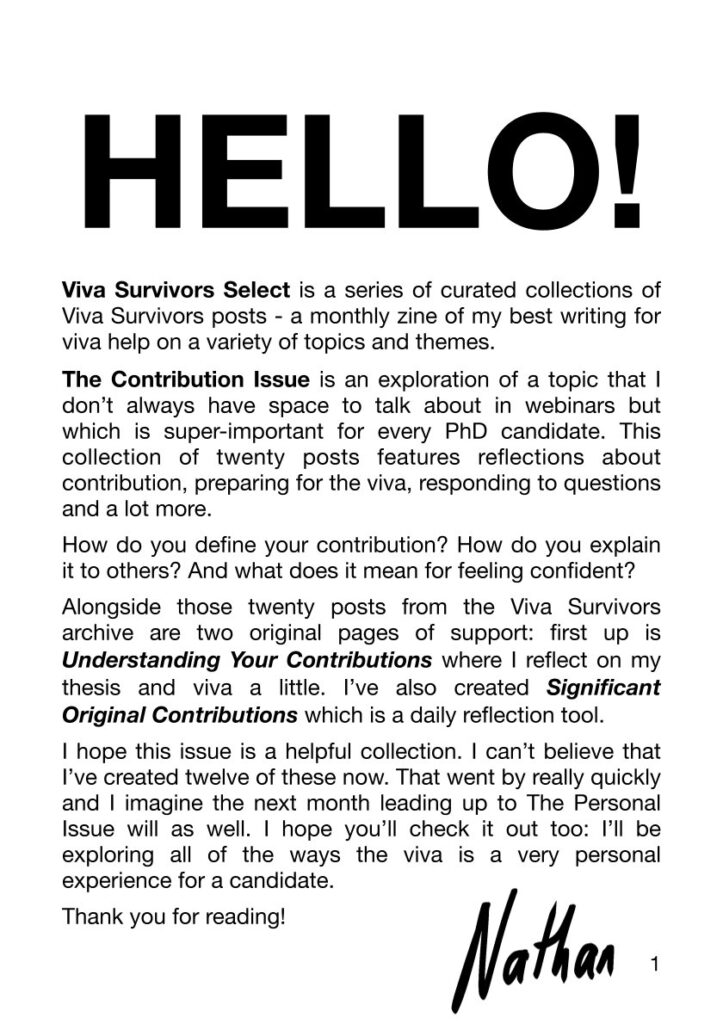
Page 1 of The Contribution Issue, titled HELLO! - an overview of the issue's contents

The Contribution Issue contains twenty posts from the Viva Survivors archive as well as two original pages of viva help. For one I get a little bit reflective myself and think back on my PhD and what my understanding of my research contribution meant for my viva. I also share a daily reflection tool for building up a summary of thesis contributions. And once again I’ve done all of the art – I’m really enjoying making art a part of what I do in 2026 🙂
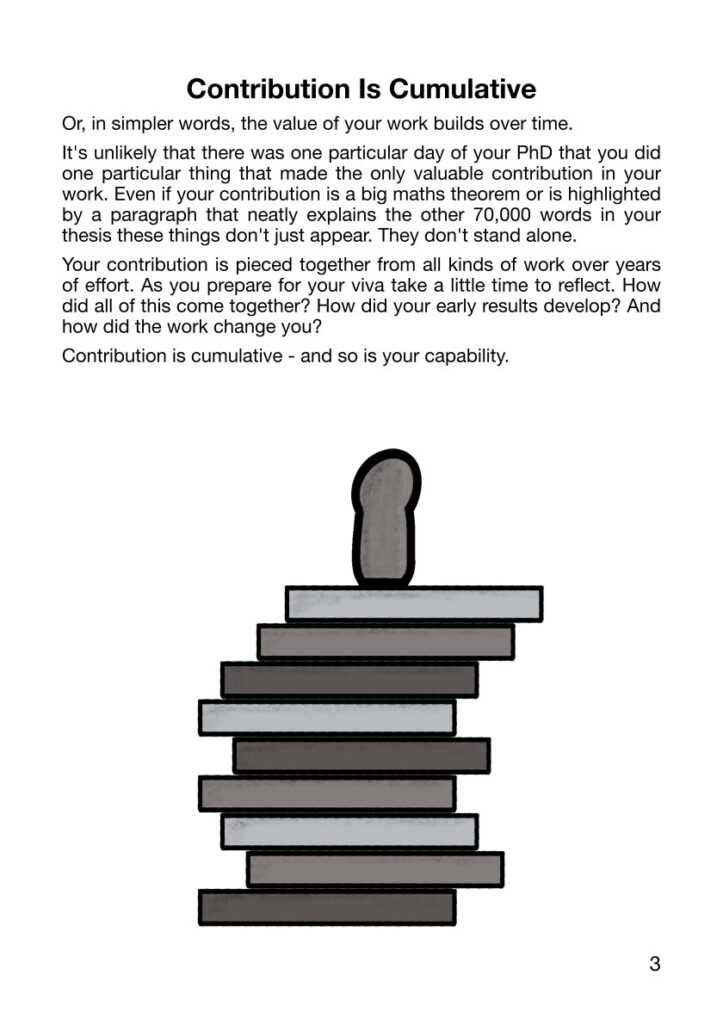
Page 3 of The Contribution Issue. A post titled "Contribution is Cumulative" takes up the first half followed by a black and white image showing a pawn character standing on top of a tower of blocks

Viva Survivors Select 12, The Contribution Issue, is out now for £3. If you like the blog, want more help and want to support what I do then please consider buying Viva Survivors Select. If it helps you then please pass on details of The Contribution Issue and Viva Survivors Select to anyone you know who is looking for viva help.

Thanks for reading!

Nathan


PS: the next collection, The Personal Issue, is due out on Wednesday 12th August 2026!

A New Approach

Congratulations if you have found a new approach or a new way of doing things as part of your research! That by itself meets the definition of an original contribution to research (and it’ll probably have some significance too!).

It’s great but it might invite questions:

  • Why is this approach more appropriate than others?
  • If there were no others how do you know that this one is good?
  • How do you defend the approach if it differs from previous expectations?

Anyone might ask these questions but they are also representative of the kinds of questions that could occur to examiners too (although theirs might be more specialised).

None of these kinds of questions are problems though. They’re opportunities to share something good. You’ve done something new. You’ve done something helpful.

It’s natural to worry or wonder but equally you can take time to prepare and even practise how you communicate your approach.

What’s The Point?

Find ways to explore and explain what your work is all about.

  • Summarise your work by writing a page or a paragraph or a sentence about each chapter. The differing scales give you different ways to think it through.
  • Take opportunities to rehearse how you describe your research. You’ll say something different to a casual friend compared with a departmental colleague.
  • Read recent and relevant publications to give more context to how your work matters and relates to your discipline.

There’s a limit to how much you can do for viva prep. The more ways you find to consider the point of your work the better you will become at responding to questions about what it means and what it does.

You don’t need to know everything or have it all worked out but you can build up experience for explaining why your work matters.


PS: I’ll dig into these topics a lot more at my live 3-hour Viva Survivor webinar on Wednesday 25th March 2026. You’ll get four-week access to a recording of the session and follow-up materials too. There’s more information at the link but please get in touch if you have any questions or want to know more. Thanks for reading!

Valuable Work

It’s a PhD expectation that you will have made a significant and original contribution to research.

Your work is valuable – so as you prepare, reflect:

  • Who will value your research?
  • What does your contribution add to knowledge?
  • Which journals might find your results and conclusions valuable?
  • What might your particular examiners find valuable?

The last question isn’t necessarily the most important but it is relevant because you’ll be talking with these two people for hours.

If there is something they might connect with then it makes sense to think about who they are, what they do and what they might really want to know – then rehearse how you might share that with them.

What’s It About?

If you want to describe your research to someone – and do it well – you have to consider who your audience is.

The general audience for your PhD thesis probably has a different knowledge and understanding than a family member who is curious about what you do. If you want to respond well to either audience you have to consider what they might know, what terms you might use and where they might find interesting parallels with their own knowledge.

The general audience for your PhD thesis might overlap with your examiners but the latter will probably have some interesting distinctions. While your research is for a wider audience it makes sense to consider your examiners particularly when you’re preparing for your viva.

You didn’t write your thesis for them but you’re preparing to meet them and talk about it. It makes sense to consider what they might know, what they probably understand and to explore what they have been working on recently to look for connections and mutual understanding.

Perfection isn’t the goal with preparing for your examiners. You’re working towards being ready to explore your research and present yourself as a capable researcher.

That’s what it’s all about.

Contribution Is Cumulative

Or, in simpler words, the value of your work builds over time.

It’s unlikely that there was one particular day of your PhD that you did one particular thing that made the only valuable contribution in your work. Even if your contribution is a big maths theorem or is highlighted by a paragraph that neatly explains the other 70,000 words in your thesis these things don’t just appear. They don’t standalone.

Your contribution is pieced together from all kinds of work over years of effort. As you prepare for your viva take a little time to reflect. How did all of this come together? How did your early results develop? And how did the work change you?

Contribution is cumulative – and so is your capability.

Five Contributions

List five contributions to research that you and your work have made, big or small. For each one, write one or two short sentences to respond to each of these questions:

  • When did you do the work that lead to this contribution?
  • Why was this work something you pursued?
  • How did you approach this?
  • Who, if anyone, supported you in this and what did they do?
  • Where does it fit in your thesis?
  • What does this contribution mean to other people?

Five contributions and several sentences for each then gives a fruitful space for further reflection.

How would you organise them? Chronologically? Can you group them into related categories? Do they have similar impact or area of impact? Did one contribution allow for another?

And, more than anything, can you see that with very little provocation there is a lot you can talk about at your viva when it comes to thinking about the contributions you have made?

Exploring Context

A key part of a viva discussion might be really getting to the heart of why you did something.

What motivated your research? Why was it worth doing? Why did YOU want to do it?

What was the need?

Why did you use your methods as opposed to other approaches? How did you select them and how did you come to think they were the best way to tackle your research problems?

A response to any of these questions might involve unsolved problems, supervisor advice, your gut feelings, your personal history, necessity, limitations and constraints, things you want to say and things you’d rather not. Exploring the context for your research helps you and your examiners discuss what you did, why you did it and how you did it. Whatever’s true will help you to have that discussion.

Be clear, share detail and explore your context at the viva. Get ready for this by finding opportunities to rehearse before you meet your examiners.

Who Is It For?

Who does your significant original contribution matter the most to? Does your explanation of your research change depending on your audience?

Reflect on who your work is for and what it might mean to different groups of people. This could help a lot when it comes to unpacking and explaining your research to your examiners.


PS: Need more ideas for reflecting on your research? Check out the latest issue of Viva Survivors Select, my curated viva help zine that digs into the Viva Survivors archive!

What’s Your Contribution?

A fundamental assumption of the viva process is that a PhD thesis has a contribution to knowledge.

What’s yours?

How do you define it? How do you explain it? What do you highlight for others?

What does someone else need to know to understand what you’ve done?

What do you hope your examiners take away from reading your thesis?

Reflecting on your contribution ahead of the viva will help you to unpack and explore it with your examiners. Taking time to read your thesis, write summaries and rehearse can all help you talk confidently and respond to your examiners’ questions.

Start simple.

What’s your contribution?

1 2 3 6