Viva Survivors Select 12
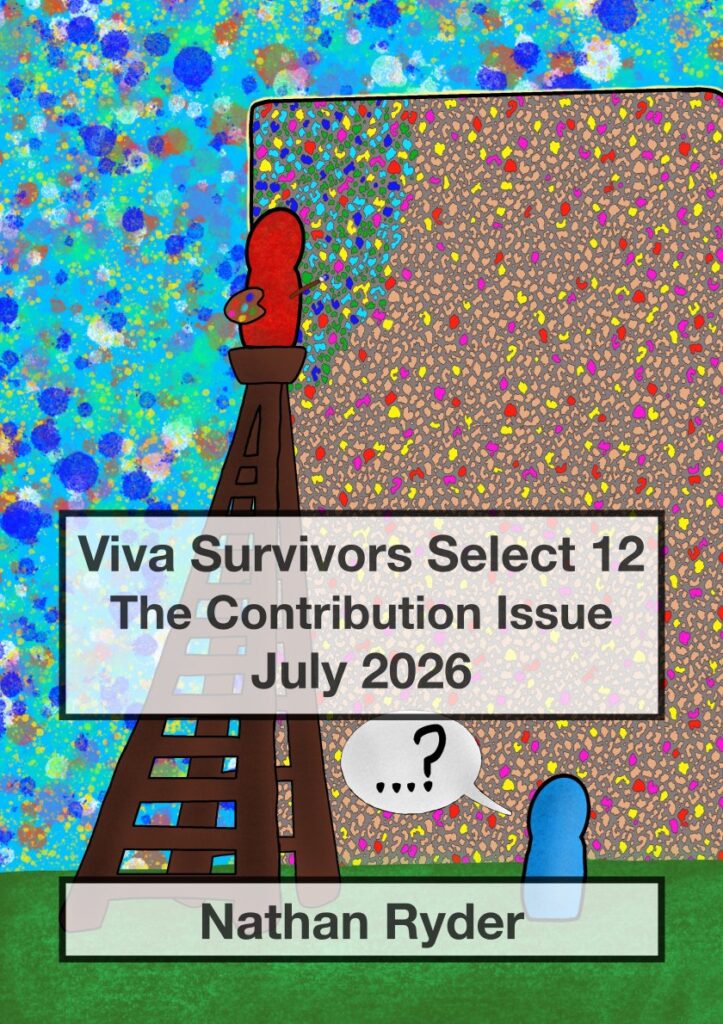
Cover for The Contribution Issue, dated July 2026. Background image shows a red stylised pawn on a ladder painting a large mural. A blue pawn has a ? speech bubble at the foot of the ladder

It’s release day for The Contribution Issue, the latest issue of Viva Survivors Select!

You can find The Contribution Issue on my Payhip store now. This issue is an exploration of what it means to make a significant, original contribution – what that means for a PhD candidate, how they can prepare for the viva and how they can use their contributions to help build up their confidence.
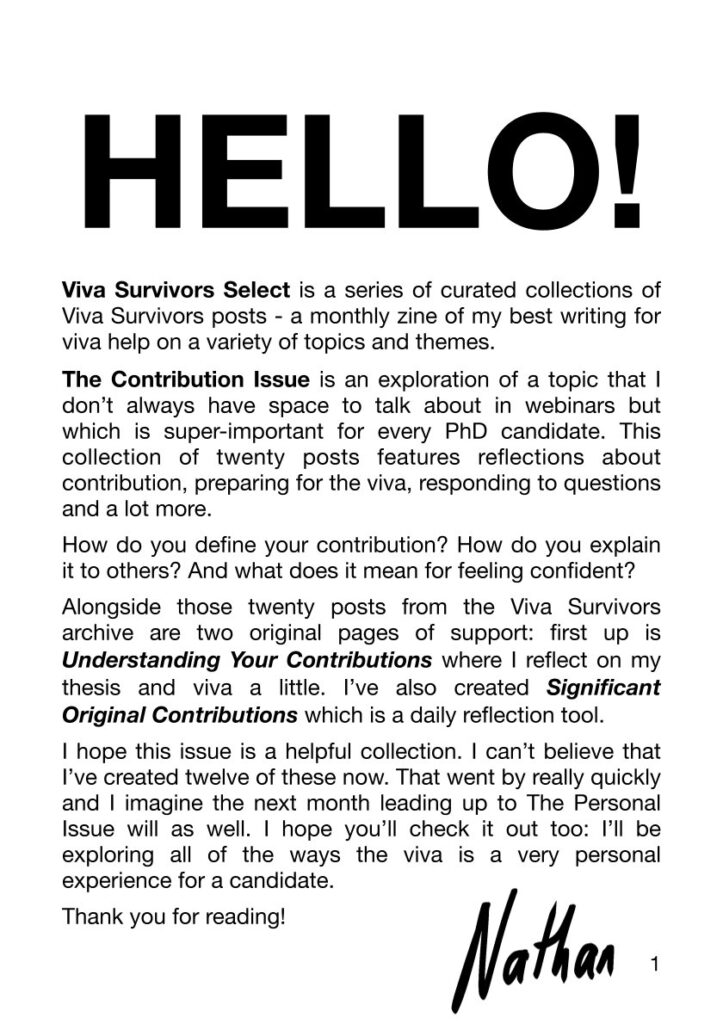
Page 1 of The Contribution Issue, titled HELLO! - an overview of the issue's contents

The Contribution Issue contains twenty posts from the Viva Survivors archive as well as two original pages of viva help. For one I get a little bit reflective myself and think back on my PhD and what my understanding of my research contribution meant for my viva. I also share a daily reflection tool for building up a summary of thesis contributions. And once again I’ve done all of the art – I’m really enjoying making art a part of what I do in 2026 🙂
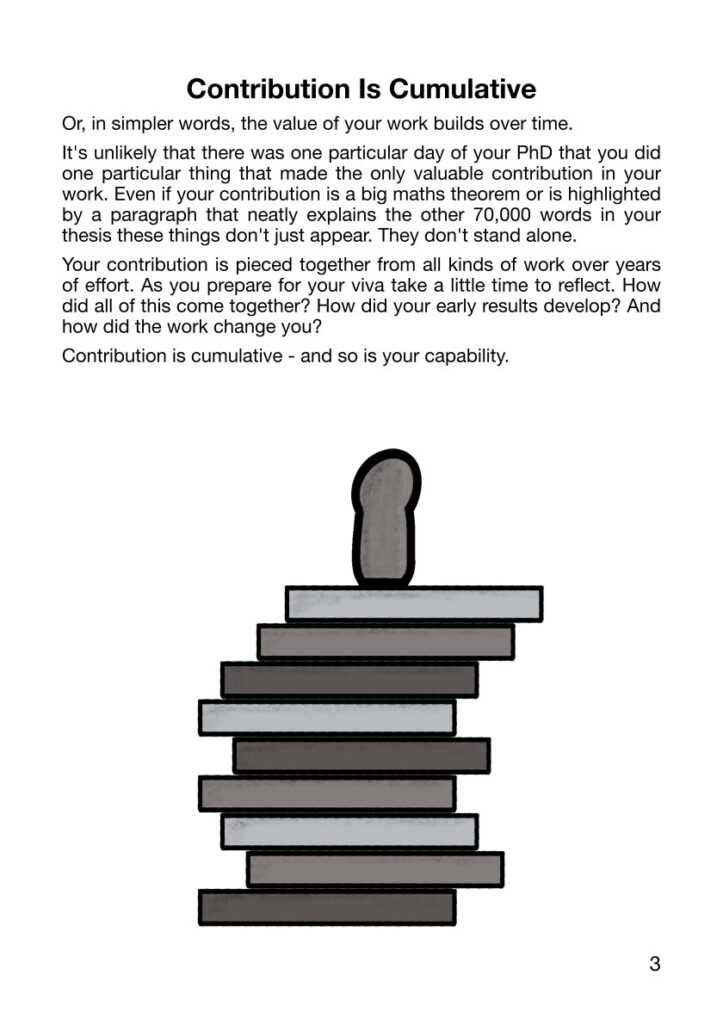
Page 3 of The Contribution Issue. A post titled "Contribution is Cumulative" takes up the first half followed by a black and white image showing a pawn character standing on top of a tower of blocks

Viva Survivors Select 12, The Contribution Issue, is out now for £3. If you like the blog, want more help and want to support what I do then please consider buying Viva Survivors Select. If it helps you then please pass on details of The Contribution Issue and Viva Survivors Select to anyone you know who is looking for viva help.

Thanks for reading!

Nathan


PS: the next collection, The Personal Issue, is due out on Wednesday 12th August 2026!

A Contentious Thesis?

Don’t worry. It means you have something interesting in your research. It means that in the viva your examiners have a lot to ask about.

And it means you’ve been working on your thesis for a long time. You will know how to engage with people who aren’t sure. With people who want to know more. With people who have their own ideas.

So read up, think, have a mock viva and conversations with friends, and get ready to explore your work.


Viva Survivors Summer Sabbatical: I’m taking July, August and September off from new writing to concentrate on other creative projects, so will be sharing a post from the archives every day throughout those months. Today’s post was originally published on May 12th 2019.

Hard Limits

There are limits for everything related to your PhD journey.

There is a finite number of hours you could have spent on your PhD.

You can’t read everything that could be relevant. You would never have time to work towards your research in a practical way.

You can’t do everything that might advance your research goals. You would never have time to write up your thesis.

You have to make choices. You have to accept the limits, like them or not. You have to work within them, whether you want to or not. And, of course, the last eighteen months will have brought more limits.

Rather than rail against the limits and the maybes and the could-have-dones, reflect on how the limits of your PhD have had an impact. Explore the difficult limitations as you might have to talk about them in the viva. Remember that despite the limits – or in some cases, because of the limits – you have made it through.


Viva Survivors Summer Sabbatical: I’m taking July, August and September off from new writing to concentrate on other creative projects, so will be sharing a post from the archives every day throughout those months. Today’s post was originally published on September 20th 2021.

Your Choices

Important questions in the viva are interested in the why of the decisions you made during your PhD.

Why this topic?

Why this method rather than that one?

Why did you decide to focus on this approach?

Take a little time in your preparation to review the choices you’ve made and the reasons that supported them.

Hard Limits

There are limits for everything related to your PhD journey.

There is a finite number of hours you could have spent on your PhD.

You can’t read everything that could be relevant. You would never have time to work towards your research in a practical way.

You can’t do everything that might advance your research goals. You would never have time to write up your thesis.

You have to make choices. You have to accept the limits, like them or not. You have to work within them, whether you want to or not. And, of course, the last eighteen months will have brought more limits.

Rather than rail against the limits and the maybes and the could-have-dones, reflect on how the limits of your PhD have had an impact. Explore the difficult limitations as you might have to talk about them in the viva. Remember that despite the limits – or in some cases, because of the limits – you have made it through.

Disagree

In your research you might disagree with something: a position taken by another researcher, the results of a paper or conclusions of a thesis.

Your examiners might disagree with a method you use, the way you interpret something, or your opinion on a topic they raise.

You might disagree with your examiners on something they think, or the way they view something you’ve done or the way they approach research.

And all of this is fine.

It’s fine to disagree but the person disagreeing has to say why.

“I disagree,” is not enough. Say why.

You would have to do this in your thesis to present your research well. To be able to engage with your examiners and their disagreements with your work in the viva you need to know why. If they don’t say initially, it’s fair for you to ask.

Ask why they disagree, if they do, and use that information to see how you can engage.

Are they making a fair point? Are they missing something? Are they simply expressing an opinion or comment? Once you know why you can respond well.

What Have You Forgotten?

I believe it’s worth reflecting on this a little before the viva.

What have you forgotten?

Perhaps you can’t know for sure. You’ve had to edit out papers, ideas and references that didn’t fit. You forgot them, to concentrate on what mattered.

Perhaps there are details that elude you sometimes; if so, what can you do make them more memorable or to summarise them?

Perhaps you view the question as an almost-irrelevance, a nonsense. How could you remember what you’ve forgotten?

I think it’s useful to remember that however much you have forgotten, accidentally or so you could focus, there must be so much more that you remember by the end of your PhD. You have a lot of knowledge, which doesn’t mean simply knowing more: you know more of what you need.

What have you forgotten? What do you remember? What do you know?

Creation or Discovery

When I was a mathematician, some of my colleagues said maths research was like sculpture. A big block of stone was chipped away at until you had the art you were trying to make. You have to start with everything and keep working until you have the proof you wanted.

I was always fond of that analogy, and of the two philosophies that followed. One mathematician might say they were really creating the maths and results. Maths is an act of creation. Another mathematician would say the maths was already there, hidden, waiting to be revealed. In this way, maths is an act of discovery. I loved hearing different takes on this, and personally, when it comes to maths I’m on the side of discovery – the ideas are out there waiting to be found!

I’ve heard similar thoughts and feelings from people in other lines of research too. Often though, I notice people enthusiastically discussing this topic but missing something fundamental. Creation or discovery don’t happen by accident, only through work. Whether you create an equation or discover it, you do the work.

Whatever you have in your thesis, whatever kind of research you discuss in your viva, it only happens because you did it.

Making An Impression

A question from a nervous candidate, “What should I wear for the viva? I want to make the right first impression on my examiners!”

Except that’s not the first impression. Your examiners’ first impression is your thesis. They get their first impression long before they meet you in the viva.

Wear something that helps you to feel confident: there are far more important questions to grapple with than what should you wear.

What have you written? What did you do? What does it mean and why does it matter?

And what impression do you hope your thesis will make?

Implications

Whatever else your thesis has – ideas, opinions, theories, hypotheses, results, conclusions – it has implications.

  • What might someone else do with your work?
  • How might they be inspired?
  • What questions do we now know to ask?
  • What questions do we know are foolish?
  • What does your thesis mean?

Thoughts in these areas could be rich for useful viva preparation – and relevant topics for conversation in the viva.

1 2 3 6